One ridiculous dance.
A piecemeal history of a strange couple, told without mathematics.

When asked to name a favourite “fact” or maybe a discovery in my field, I feel I am being asked to describe something neatly. Compact. Which, given what the Earth (and all other messy sciences) are, is often wrong. To me it will also feel wrong. The caveats, discussion of error, disputes over methods and reasoning, or musing on the fact that we don’t entirely understand a subject, are the meat of a scientist’s day to day work1. So that is usually what we (or many of us) care the most about. The only time a scientist might feel at peace following such a question is if you, foolish instigator, are comfortable with a saga. An absurd tale filled with challenge, plot twists, conflicts between titanic egos and far too many details.
For that reason, my favourite response to such a question used to be something along the lines of: “Our Moon. A ball of rock whose formation at the right time, at roughly the right mass/composition, formation distance and initial angular velocity might be a key reason for life ever doing anything more interesting than wiggle”.
The Moon is too old
“Here lie the bodies of Ho and Hi Whose fate though sad was visible, Being hanged because they could not spy Th'eclipse which was invisible.”
—Unknown Author (2137 B.C.E.)2
Ho and Hi often introduce our tale in the observatories of ancient Mesopotamia. Eclipses were of the highest importance to ancient Babylon, and their records of eclipses are centuries long, noting Solar/Lunar eclipses, partial eclipses and the event duration. They collected centuries of data, an astounding achievement even by modern observational standards, which with observations from a few other locations in Asia constitute our oldest measurements of the solar system. The Babylonian astronomer was mostly interested in predicting the next eclipse (or possibly just avoiding execution). Yet as time marched on, the scientific value of the Babylonian dataset for understanding the mechanics of eclipses would outlive their civilization. Within a few thousand years, on a damp island in northern Europe, Edmund Halley was attempting to make use of this record to apply Newton’s theories for eclipse prediction3. He encountered a problem. Having dealt with both translation and mathematical errors by the intermediaries that sourced his ancient data, the computed timing of his eclipses were slightly shifted relative to the times of known eclipses by a few hours4.
A small shift might seem minor, but this means that the location of the total solar eclipse would occur thousands of kilometres away from its recorded location when he “ran the clock back” through the physics.
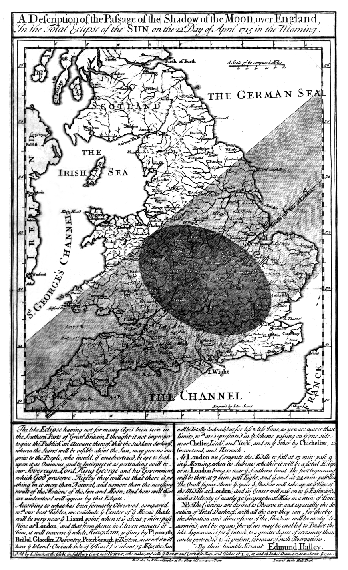
If these errors were systematic, that is you couldn’t blame random measurement error, then Halley could see two possible explanations. Either, the Moon was accelerating away from the Earth, or the rotation rate of the Earth had slowed since the time of the Babylonian eclipses. While Halley correctly identified the slowing rotation, both phenomena were in fact present, but it would be centuries before we could explain why.
A seemingly unrelated problem would appear again, centuries later5. When the Apollo missions returned to Earth throughout the 1960s and 70s, they ferried samples of Moon rock, in exchange for components of one of the most impressive experiments ever built - the reflectors of the lunar ranging experiment. The goal of the project is self explanatory, to provide a more precise estimate of the Earth-Moon distance using laser ranging6. With observations and slide rules in hand, geophysicists could test the dynamics of the Earth-Moon system in a way that Halley and Newton could not have even dreamed of. While the experiment confirmed the typical distance between the Earth and Moon (and many careers worth of other things besides), it confirmed Halley’s theory that the Moon is accelerating away from the Earth at a little over 3 cm per year and that Earth’s rotation rate was slowing.
Now, the Moon rock was more than just ballast. Destined for laboratories in the US and elsewhere, these samples would finally provide the means to answer longstanding questions surrounding the Moons composition and age. As results were collated and compared, a typical age of around 4.4 billion years was found for the geological samples. But there was a problem. Running the physics “back in time” (not unlike Halley’s eclipse estimates) the Moon’s age derived from the now laser-measured lunar acceleration was a little under 1.6 billion years old.
Once again - tidal friction
There is a very practical reason for oceanographers to care about a rather niche string of scientific history. The answer to Halley’s increasing day length and the age discrepancy from the Apollo era is due (in large part) to the ocean’s dynamics, specifically in its tides. Other processes have an effect on the Earth-Moon orbital dynamics, including atmospheric motion, ice sheet melt and the enigmatic behaviour of Earth’s mantle. Even the construction of large dams. But it is the fact that we have an ocean tide that really matters here.
You probably know that as the Moon orbits “overhead”, it’s exerting a gravitational force (or, it possess a gravitational potential) everywhere over the Earth towards its own centre. But locally this force is very weak, small objects do not fly towards the Moon even when it is at its closest. No, relative to Earth’s gravity this force is quite feeble, but it does exist. So at every point on the planet there will be a small imbalance between the local force of Earth’s gravity and the Moon’s - it is this small imbalance which overcomes the ocean’s inertia, with the ocean taking on a shape that aligns with the gravitational potential.
An ocean is easier to move than solid rock. Yet less so than atmosphere (yes, there is an atmospheric tide), in large part due to the deceptively simple process of friction.
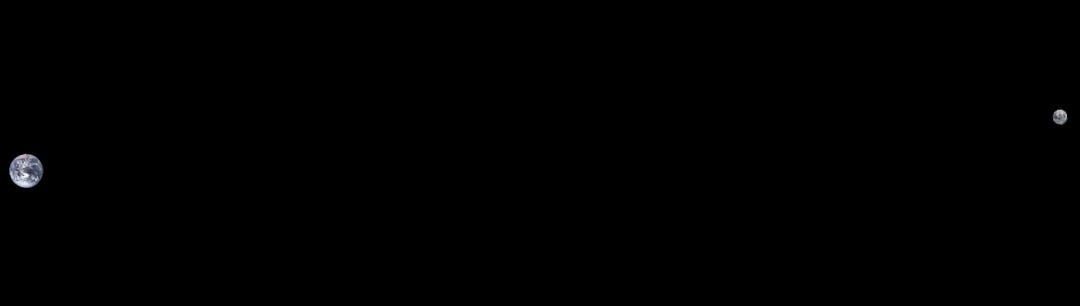
The oceans cannot react instantly to the Moon’s gravitation as it passes above. If they could, you might observe something similar to Newton’s original equilibrium tide. Instead, they occur in world where there is friction at the seabed. The oceans are also bounded by continents stretching North-South across most of the planet. This resistance (through friction) and the Earth’s greater rotation rate relative to the Lunar orbit drags the tidal waves slightly ahead of the Moons orbit. The irregular ocean basins also mean the tidal waves do not look like Newton’s smooth equipotential surface, but propagate as complex waves. These properties were roughly understood even in Halley’s time - it was clear from the few tide gauges around the world, that Newton’s equilibrium model could not fully describe this system. But how do these features explain a late eclipse and an old Moon?
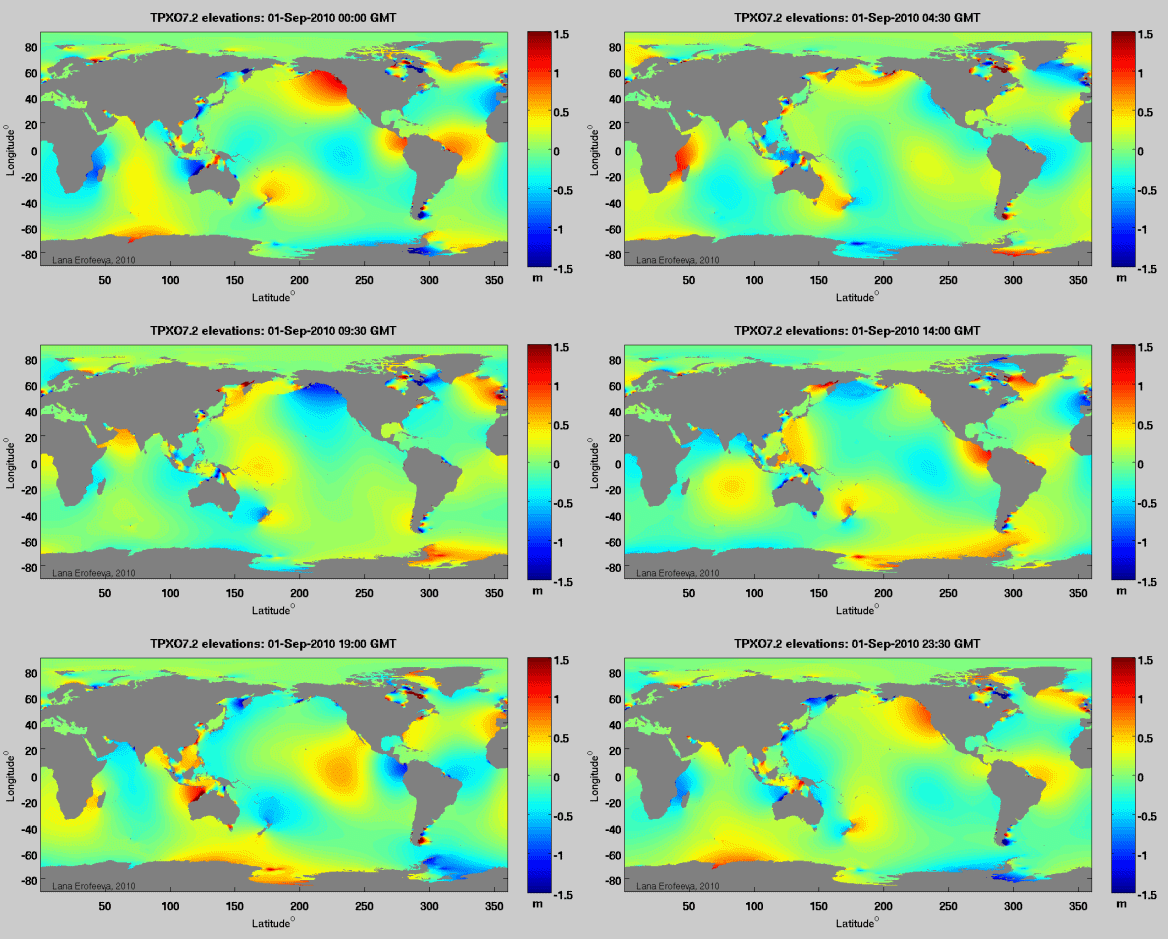
Physically, the answer to Halley’s quandary is that the ocean tides are an energy sink from the Earth-Moon system. There is a small lag between the high tides on Earth, and the Moon’s position overhead (sometimes called the “age” of the tide), the tidal wave is actually dragged slightly ahead of the Moon. This small difference exerts a torque over the entire planet, a lunar hand-break. The torque dissipates energy from the Lunar orbit, slowing Earth’s rotation and (because the Earth and Moon must conserve angular momentum) causing the Moon to slowly drift away. A common but appropriate analogy is of the ballet dancer extending her arms to slow her spin, or rapidly drawing them in to accelerate. The energy lost to the oceans dwarfs that lost in the tidal squeezing the of the rocky Earth or our low density atmosphere.
I have loosely associated the words “friction” and “tides”, but there are some important subtleties to discuss. While we can now explain Halley’s late eclipses unfortunately, the Moon is still too old.
When we were finally able to observe the ocean surface from space and began making calculations of these tidal energy budgets, a new problem emerged. Only a small fraction of the energy lost to the oceans took place through the form of friction you might have an intuition for - the removal of energy from a current flowing one way and then another in the shallow parts of the ocean. It had to be found somewhere in the deep ocean, but the tidal currents there are vanishingly small. Fractions of a millimetre per second at most. So small in fact, that it would be impossible for that process to close the energy budget. The missing energy sink deserves several essays, but in short the barotropic tide creates another form of “tide” - enormous oscillations within the ocean, waves, around the mountains and hills of the deep sea. These baroclinic tides (to add the jargon) radiate away and eventually break, converting their energy in to mixing of the sea water. Some particularly beautiful examples are the great tidal beams radiating away from the Hawaiian islands.

These enigmatic processes appear to be the missing energy sink from the Lunar tide. Across all of the oceans tidal processes, ~3.5 Terrawatts (1 Terrawatt is 1012 Watts) of energy are stripped from the surface tide to the myriad other fluid processes within the ocean’s dynamics. The final destination and critical function this energy plays on Earth will be left to appear in a future ramble.
If I could turn back tides
Now, when you are trying to understand a system (universe, ocean or toaster), you should simplify the problem. If needed, the complexity of your solution can be increased, but only to what is required7. The problem with geophysics and other “messy” sciences is that the complexity of the problem often remains high even after you have done your best to simplify it. The Earth and Moon most likely started their co-dependency close together. The Moon formed following an apocalyptic impact between the Earth and another large rocky body of the early solar system. Yet the young planet also likely developed liquid water oceans in geologically short order, oceans in which a tide could be raised.
When we find a young Moon by winding its current acceleration backwards in time, the implicit assumption is this rate has been constant for all that time. And there is good reason to think otherwise. Remember, the Moon’s acceleration is proportional to how much energy is stripped out of the system by the tides - so if the Moon had to have receded more slowly than previously thought, were the tides over all that time less energetic than today? Work done by some of my colleagues strongly suggests that this the case. The key to understanding how, is the phenomena known as tidal resonance. As the surface tides move as waves they can, when the geometry of the basin is right, reinforce each other - sometimes called constructive “interference”. If the geometry is poor, usually when the distances to cover are large relative to the wave or the basin too shallow, then the tide will be damped out. And the ocean’s have changed considerably over the last 4.4 billion years.
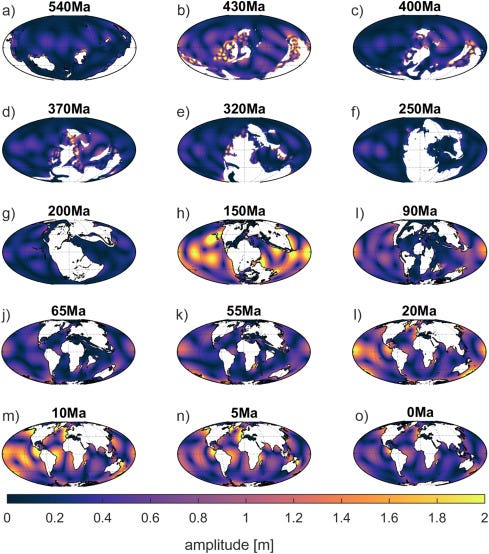
Thanks to the diligent work of several generations of geologists there are now many estimates of the shape and distribution of the past continents and oceans. Using them as the physical boundary conditions for simulations of Earth’s tides, you can estimate how different the total energy loss from the tides could have been, which will give you some idea of how much the Moon could have accelerated away and Earth’s rotation rate slowed. As the oceans widened then narrowed and the continents have danced around themselves, the tides have responded, moving up or down a gear depending on the chaotic evolution of Earth’s surface. While these simulations are still approximations, what is clear is that our present tides are oddly energetic.
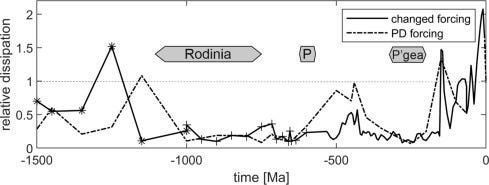
There is still a great deal of work to be done. Recovering any scientific understanding about the Earth as you move back through the geological record moves from simply difficult to the realm of speculation. For example, the shallow seas surrounding Earth’s continents today are often tidally energetic - with high current velocities and their own own smaller-scale resonances. And their global effect is significant - the shallow seas are responsible for about 1TW of the total energy loss. But reconstructing the comparable environments of Earth’s past, say 300 million years ago, is hampered by the fact that tectonics also destroys most of the evidence in the Earth’s mantle.
There is, to my knowledge anyway, no way of identifying the single, chaotic and historically contingent history of Earth’s tidal dissipation from pure theory. It is a “complex” problem solely because the information we need to resolve it, Earth’s historic geometry and bathymetry, has been taken from us. It is one of those scientific challenges that while simple in principle, becomes humbling as your knowledge of it increases.
“… do those look similar to you?”
There is a story, apparently common among teachers, of children looking at a world map and asking whether South America and Africa once fitted together - only to be hushed by a teacher cruel enough to work prior to the general acceptance of plate tectonic theory. I have sometimes wondered whether anyone has asked a similar question about the size of the Moon and the Sun. I do not mean their true size, but their angular size in the sky as we see them from the Earth. We live on a planet where the angular size of the primary satellite and our star are so close as to be within a few percent of each other. Now the reader’s response, given you have made it this far, might reasonably be “and?..”. There does not seem to be an obvious reason to care about this fact.
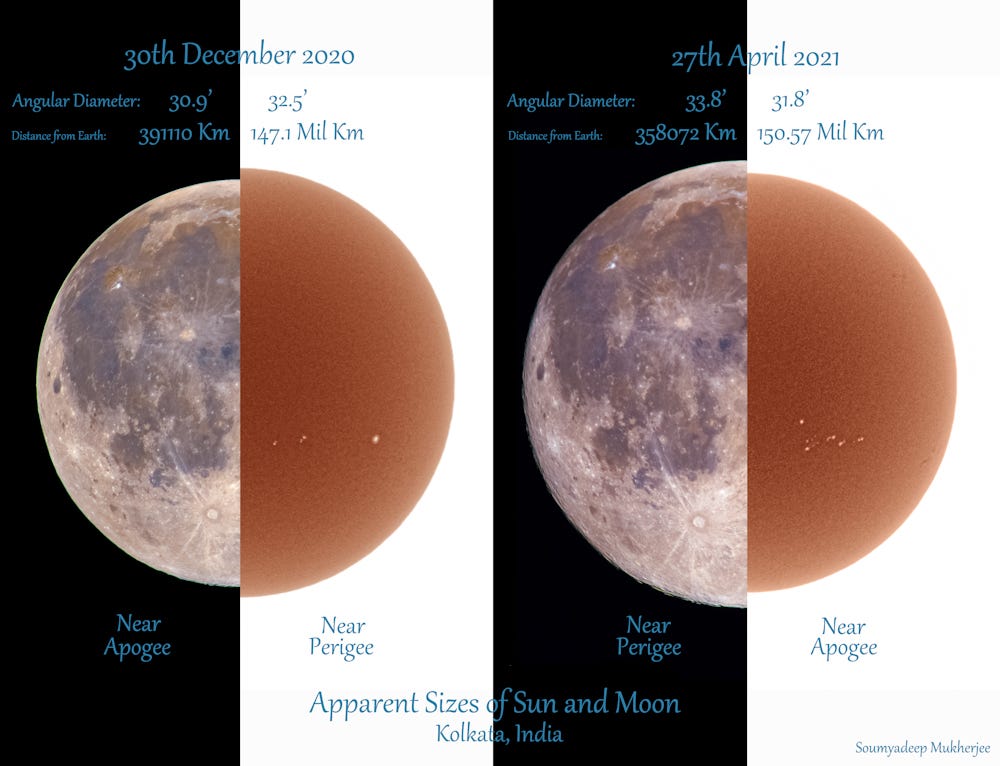
A few years ago the, the astrophysicist Prof. Steve Balbus made the following argument:
The Sun’s contribution to the total tidal force acting on the Earth is a fraction of the Moon’s. Now this force results from the mass of the tide raiser (Moon or Sun), but that also means it depends on the average density of that body i.e. if the density of the Moon were greater, it’s gravitational effect would be greater (assuming no change in separation distance ect.) The strange result here (and I strongly encourage the interested to read that paper), is that if the densities of the Sun and Moon were the same, their tidal effects would be equal - simply due to their nearly equal angular sizes in the sky. Indeed he makes a point of showing that Earth’s tides are quite sensitive to even small differences in this ratio.
The specific property of Earth’s tides that this matters for is the Spring-Neap tidal beat. “Spring” tides are the highest and lowest tides, while “Neaps” have a much narrower range. If the ratio of these bodies in sky was a little different, or their material composition or distances moderately different enough that Sun’s tide was not roughly half that of the Moon’s, this effect would not occur. Without with Lunar tide, this pattern ceases to exist (see below).
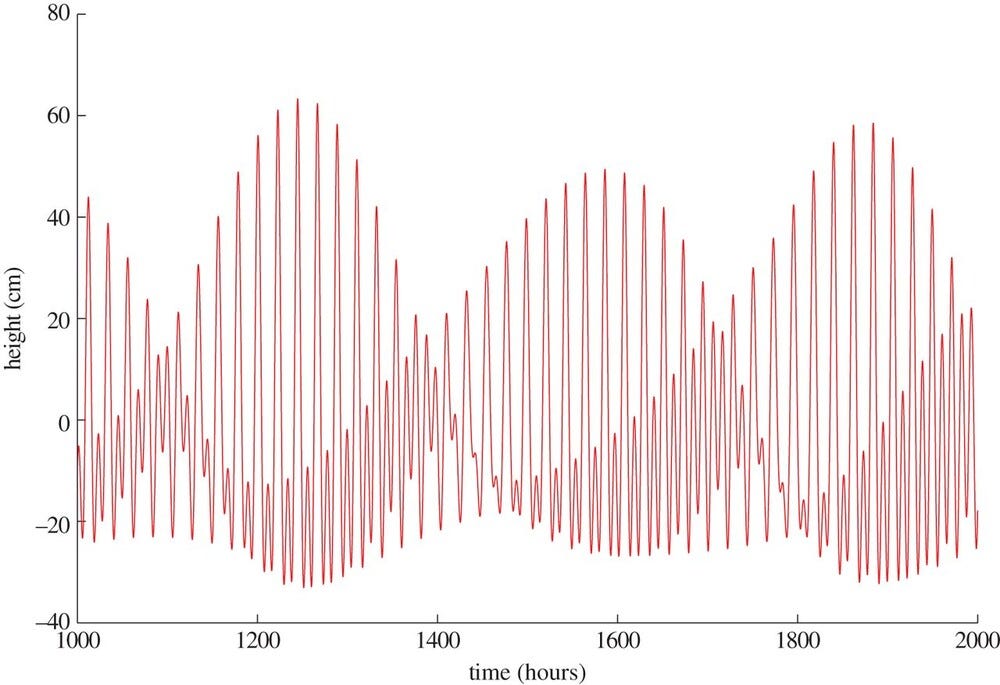
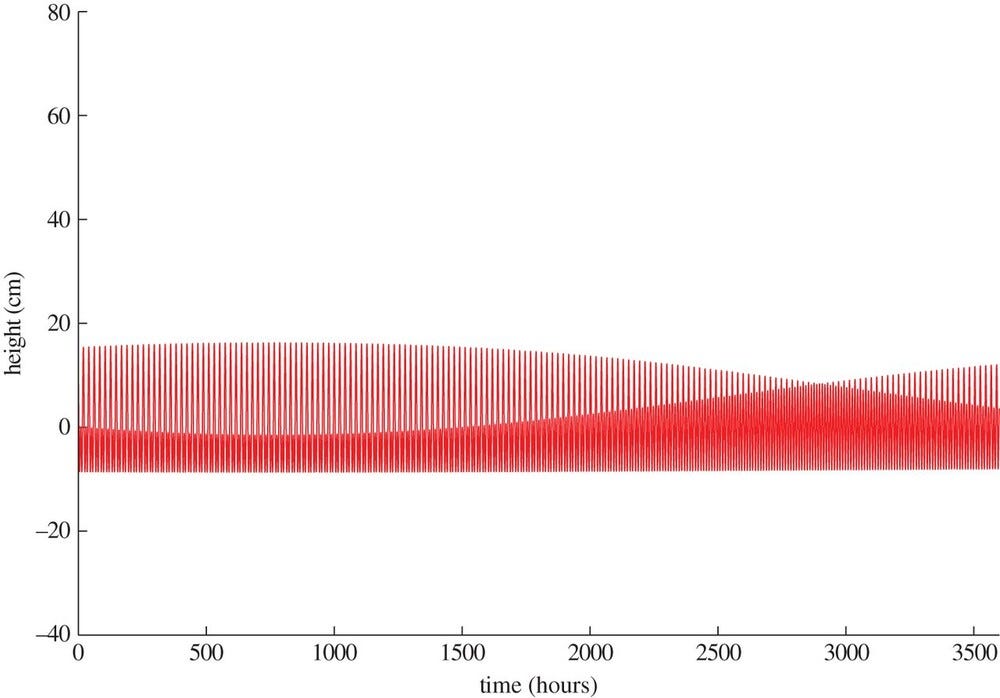
Balbus was not just interested in explaining this coincidence mathematically, he made a point of asking whether there might have a been a period in Earth’s history when the presence or absence of a Sun-Moon tidal beat would have mattered. The Devonian for example. This period has famously produced the first evidence of tetrapods taking their first steps on to land, steps which were ultimately required for our own ancestors to develop as they did.
The potential link between tide and amphibian here is an odd one. We can show that the Devonian continents were often fronted by large deltas, mud flats and inter-tidal environments. It also appears that, as in Balbus’s simulations, the tides of this period underwent a large Spring to Neap shift, with the sea’s edge moving potentially tens or hundreds of kilometres depending on the location. The geometry of the Devonian oceans seem likely to have been in that special near-resonant state (not the best example but see the panel above 400 - 320Ma), enhancing the tidal range and extreme nature of the Devonian coast. This would be a strong selection pressure for an unfortunate amphibian, perhaps a state where animals with robust legs could move between the remaining less stagnant pools, until the sea returned. In this model, curiously, it is the need to return to the water that spurs an evolution of strong legs, rather than some pull towards the land8.
I feel it is worth reiterating that there is no physical reason for this state of affairs to have occurred. That anyone has been able to find at least. It seems unlikely that a planet’s primary satellite should nearly match the angular diameter of their star, and maybe as exoplanet science proceeds we will learn whether this orbital setup is more common than we might assume. But at the moment we really have no idea.
But it is clear, that with even minor changes to the relative diameters and distances of the two bodies, our ocean dynamics could have been fundamentally different9. And perhaps evolution would have played an alternative kind of game, to quote Balbus - “if it is necessary to have the sort of heavily modulated tides we experience on the Earth in order to influence a planet’s evolutionary course in a manner constructive for evolving complex land-based organisms, the mystery of nearly equal angular sizes of the Sun and Moon would evaporate, rather like an inland Devonian tidal pool”.
Curiouser and curiouser
This was too long with far too many details - although I did imply that might be the case. It also happens to be one of my favourite examples of scientific advancement that almost no one has heard about. While the key facts of the case (Lunar recession due to energy loss to the tides) seem unlikely to change appreciably, many other parts of the story could evolve drastically. The details of the “deep-time” tides, how they have and will continue to evolve, and the special implications of our planets tides for everything else remain objects of debate and yes, speculation.
It is a strange situation, to be presented with a very robust body of theory, but to also know that the evidence for many of its predictions must remain limited, or even inaccessible. Earth’s tidal drama steered me in to science, and while I have not done service to the breadth and technical depth of the actual work, I hope this starts to give you an idea of what a scientific saga can look like. Ho and Hi cannot have begun to comprehend the developments that would follow them. Neither could Halley and Newton. The legends from NASA and cold-war geophysics may have been surprised that their work could shed light on anything to do with origin of their own legs. While I certainly do not put myself in the same category as them, this story strongly suggests I have a limited grasp on future developments in the Earth sciences as well. It’s really quite exciting.
Alas, a lie. I mostly just swear at coding errors I made the previous week.
I would really love to know how they make the translation choices when translating poems, songs ect in dead languages. If anyone has anything good to read on the subject let me know!
If any academics are reading this, this is what “research impact” looks like.
I have many questions about the error surrounding ancient eclipse observations… but this is a nice story so we’re putting them aside for the moment.
To my knowledge, with few attempts to explicitly test Halley’s theoretical suggestions.
The technical achievement here is astonishing. Given the losses to the atmosphere from the laser (of the outgoing and incoming beam), the losses at the lunar surface and the fact of beam spread, the receiver arrays on Earth may only intercept something on the order of 1 in ~10^21 of the incoming photons. It almost seems wrong to consider this a “beam”..
This is actually what Occam’s razor states - not, “the simplest solution is the right one”, as many seem to believe. A weird effect of the razor though, is that very often a simple (if not the simplest) solution is the correct answer, something that has no particular reason to be true.
Many good counter-arguments from evolutionary biologists could be listed here. There are many… But, I am not a palaeo’ guy and it is a conveniently cool coincidence :)
At some point soon (maybe): what ocean/atmosphere dynamics does on a flat Earth and what happens to all the plankton if we blow up the Moon?